

In the modern e-commerce supply chain, the Sortation Center (SC) acts as the critical operational bridge between the “First Mile” (warehousing) and the “Last Mile” (delivery). While Fulfillment Centers (FCs) focus on storage and packing, Sortation Centers are engineered for speed, routing, and consolidation. They are the “backbone” because they decouple inventory management from transportation logic, enabling the affordable 2-day and same-day delivery standards that define the industry.
By aggregating volume from multiple FCs and sorting it granularly for local post offices or delivery stations, SCs allow retailers to bypass expensive long-haul zones and maximize truck utilization.
1. Strategic Role: The Network Connector
The primary value of a sortation center is consolidation. Without SCs, every Fulfillment Center would need to sort packages for every possible destination zip code—an operational impossibility.
- Decoupling Inventory from Geography: FCs can focus purely on picking and packing without worrying about the destination. They simply ship mixed-destination trucks to an SC.
- Zone Skipping: SCs enable “zone skipping,” where parcels are aggregated and moved long distances in bulk to a local SC near the customer, bypassing expensive carrier hubs and lowering shipping costs per unit.
- Peak Flexibility: During high-volume periods (Prime Day, Black Friday), SCs act as “shock absorbers,” buffering volume so last-mile carriers are not overwhelmed.
Comparison: Fulfillment Center vs. Sortation Center
The distinction between these two facilities is often misunderstood but fundamental to logistics strategy.
| Feature | Fulfillment Center (FC) | Sortation Center (SC) |
|---|---|---|
| Primary Function | Storage, Picking, Packing | Receiving, Sorting, Routing |
| Inventory | High inventory (shelves, pods, pallets) | Zero inventory (cross-docking model) |
| Key Metric | Orders Picked Per Hour (UPH) | Packages Processed Per Hour (PPH) |
| Dwell Time | Weeks or Months | Hours (typically <24 hours) |
| Output | Individual boxes to SCs or Carriers | Pallets/Gaylords by Zip Code |
2. Operational Anatomy: Inside the Machine
A Sortation Center functions as a high-speed cross-dock. The goal is to touch the package as little as possible while moving it as fast as possible.
The Workflow
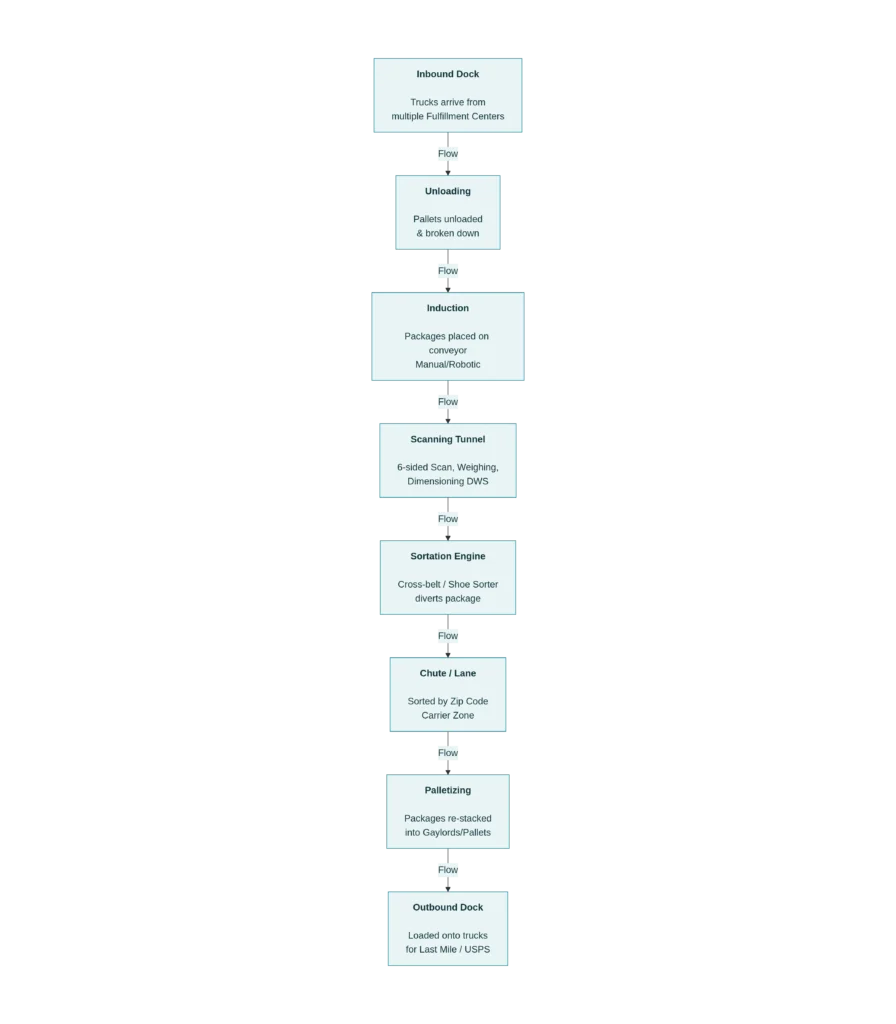
- Inbound & Unloading: Trucks arrive from various FCs carrying “dirty” (unsorted) pallets. These are unloaded and moved to staging areas.
- Induction: This is the bottleneck and most critical step. Associates or robotic arms place packages onto the main conveyor belt. They must be spaced perfectly (“singulated”) to allow the scanner to read them.
- Scanning (The “Tunnel”): Packages pass through a 6-sided scanning tunnel equipped with high-speed cameras and dimensioners (DWS – Dimensioning, Weighing, Scanning). This system reads the barcode, weighs the package, and queries the Warehouse Control System (WCS) for the destination chute.
- The Sortation Engine: The WCS tracks the package’s exact position on the belt. When it reaches its assigned divert point, the system triggers a mechanism (shoe, tray, or belt) to push the package into a specific chute.
- Containerization: Packages slide down spiral chutes into “Gaylords” (large cardboard boxes on pallets) or canvas carts. Each container corresponds to a specific zip code range or a specific post office.
- Outbound: Once a container is full, it is closed, wrapped, scanned, and loaded onto a truck destined for a Last Mile Delivery Station (DS) or a carrier hub (e.g., USPS, UPS).
3. Technological Enablers
Modern SCs are defined by their level of automation. A manual facility might process 2,000 packages per hour, whereas a fully automated “superhub” can process 30,000+ packages per hour (PPH).
High-Speed Sortation Technologies
- Sliding Shoe Sorters: The industry workhorse. Aluminum “shoes” slide across the conveyor slats to gently push cartons into a lane.
- Cross-Belt Sorters: A series of small motorized belt carriages riding on a track. The belt spins left or right to discharge the item.
- Tilt-Tray Sorters: Trays that physically tilt to dump the package.
AI and Robotics
- Computer Vision: Advanced cameras use AI to detect damaged packages before they are sorted, preventing jams and customer returns. Systems like Amazon’s “Robin” can identify label defects and reroute packages automatically.
- Robotic Induction: Robotic arms with suction grippers are replacing human inductors, capable of lifting heavy boxes 24/7 without fatigue.
- Autonomous Mobile Robots (AMRs): Instead of fixed conveyors, some newer centers use fleets of hundreds of small robots that carry individual packages to their chutes. This system is highly flexible and scalable—if you need more capacity, you simply add more robots.
4. Future Trends (2025 and Beyond)
The role of the SC is evolving from a passive router to an active intelligence node.
- Micro-Fulfillment & Urban Sort Centers: As cities become denser, the massive 1M sq. ft. SC is being complemented by smaller, urban sort centers. These facilities sort for a specific neighborhood, enabling 1-hour delivery windows.
- Sustainability Integration: SCs are becoming the charging hubs for electric delivery fleets. The “Outbound” dock is being redesigned to support rapid charging for electric vans while they load.
- Dynamic Routing: Traditionally, a zip code was hard-coded to a specific chute. New AI systems now dynamically change chute assignments in real-time based on truck availability and traffic data, ensuring no lane overflows while others sit empty.
Conclusion
Sorting Centers are the unsung heroes of the “Amazon Effect.” While consumers focus on the “Buy Now” button and the delivery van, it is the Sortation Center’s ability to process tens of thousands of parcels per hour with 99.9% accuracy that makes the economics of modern e-commerce possible. As logistics demands speed up, these facilities will continue to automate, moving closer to a “lights-out” operation where packages flow from truck to truck untouched by human hands.