

A cold storage warehouse is a specialized facility designed and engineered to maintain precisely controlled, low-temperature environments for storing temperature-sensitive products. Unlike traditional warehouses that prioritize space organization and general logistics, cold storage facilities are fundamentally centered on temperature control and environmental preservation. These facilities are essential infrastructure in the modern supply chain, enabling the preservation of perishable goods, pharmaceuticals, and other temperature-sensitive materials across extended periods and long-distance distribution networks.
The primary function of cold storage warehouses is to inhibit spoilage by slowing down or halting biological and chemical processes that lead to product degradation. By maintaining specific temperature ranges, these facilities extend shelf life, preserve nutritional value, prevent bacterial growth, and maintain product integrity across diverse industries including food and beverage, pharmaceuticals, healthcare, and industrial sectors.
Types of Cold Storage Warehouses
Cold storage facilities are classified along two primary dimensions: operational ownership structure and temperature maintenance specifications.
By Ownership and Operation:
Private cold storage warehouses are owned and operated by the same enterprise that manufactures or retails the stored goods. These facilities are typically located adjacent to manufacturing operations and connected via conveyor systems for efficiency and quality control. However, private cold storage represents a minority of facilities due to substantial capital investment requirements, complex engineering, and ongoing regulatory compliance costs. Only large multinational corporations such as Nestle and Kraft maintain extensive private cold storage networks.
Public cold storage facilities, conversely, are owned and operated by third-party logistics (3PL) providers and serve multiple client companies simultaneously. Public facilities dominate the industry, offering flexible rental arrangements, scalable capacity, and specialized services including assembly, kitting, quality control, and distribution. This model distributes infrastructure costs across multiple users, making temperature-controlled logistics accessible to small and mid-sized enterprises.
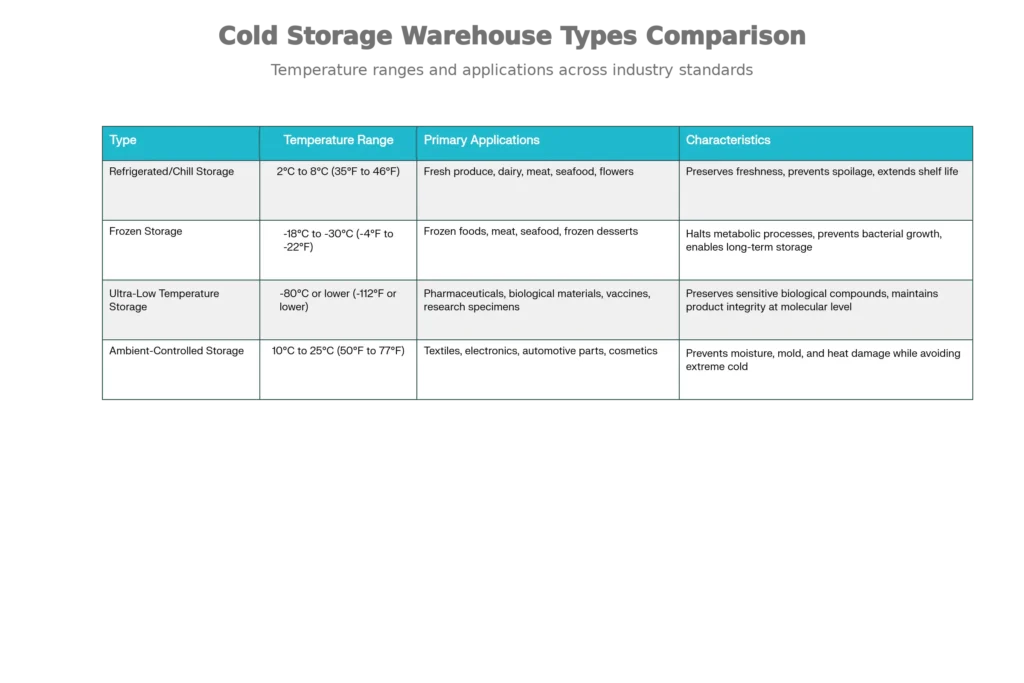
By Temperature Classification:
How Cold Storage Works: The Refrigeration System
Cold storage warehouses operate through a continuous refrigeration cycle that systematically removes heat from the warehouse environment. Understanding this mechanical process is fundamental to appreciating how these facilities maintain stable, low temperatures despite external environmental pressures.
The Refrigeration Cycle:
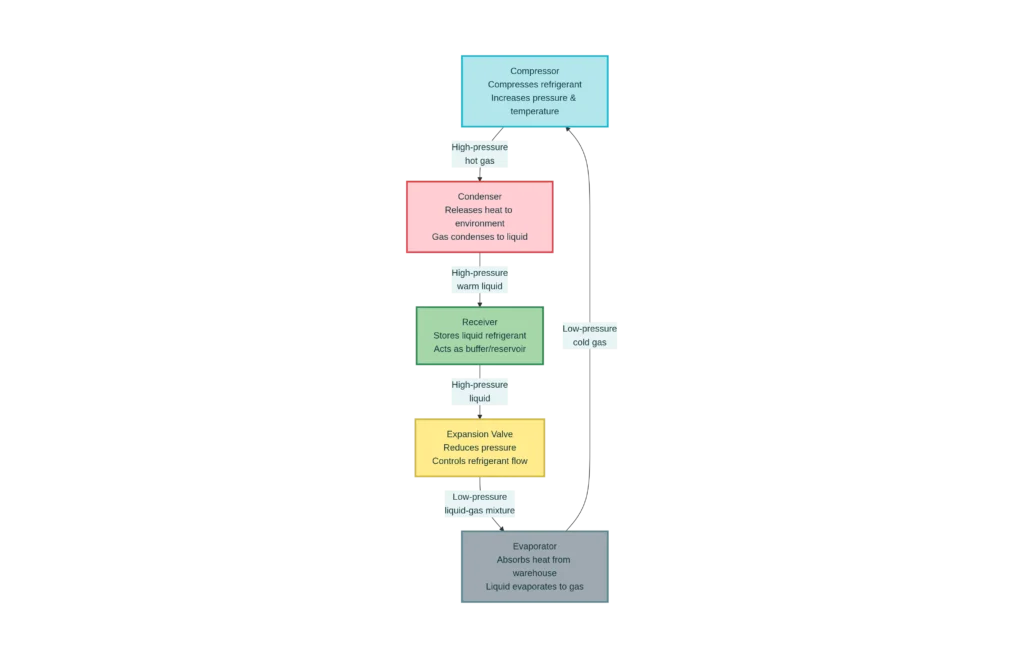
The refrigeration system comprises seven interconnected components that form a closed-loop cycle:
Coolant (Refrigerant) serves as the heat-transfer medium, continuously circulating through the system and undergoing phase changes between liquid and gaseous states. The refrigerant absorbs heat from stored products and the warehouse environment, effectively lowering the internal temperature.
Compressor functions as the mechanical heart of the system, increasing the pressure and temperature of the refrigerant gas. This pressurization is critical because it drives the entire cooling cycle and enables the refrigerant to release heat at the next stage. Modern compressors often incorporate variable speed drives (VSDs) that modulate operation based on cooling demand, reducing energy consumption during periods of low load.
Condenser receives the high-pressure, high-temperature refrigerant gas from the compressor and removes excess heat, converting the gas into a high-pressure liquid. Heat is released to the external environment through metal coils and forced convection.
Receiver temporarily stores the high-pressure liquid refrigerant before it proceeds to the expansion valve, ensuring a consistent supply and optimizing the efficiency of the entire cycle.
Expansion Valve reduces the pressure and temperature of the liquid refrigerant through a throttling process, transforming it into a low-pressure liquid-gas mixture. This pressure reduction is essential because it prepares the refrigerant for the final cooling stage.
Evaporator is where the primary cooling occurs. The low-pressure refrigerant absorbs heat from the warehouse environment and stored products, vaporizing back into a gaseous state. As warm air passes over the evaporator coils, the temperature differential causes rapid heat transfer to the cold refrigerant.
Blowers distribute the cooled air throughout the warehouse via convection, ensuring uniform temperature distribution across all storage zones and preventing the formation of warm spots that could lead to product spoilage.
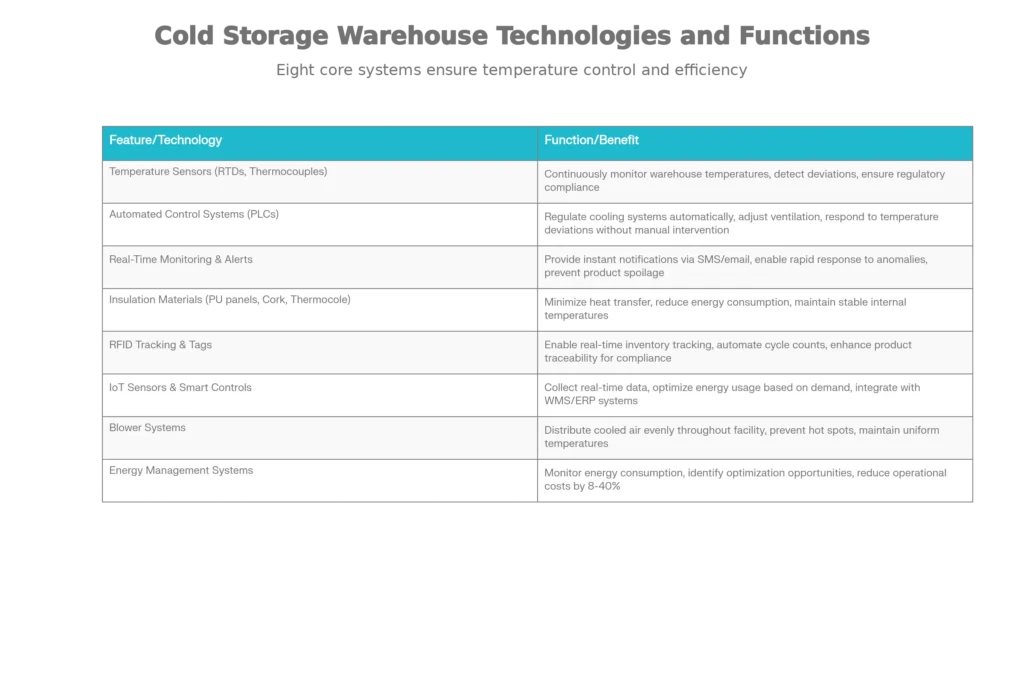
Temperature sensors integrated throughout the facility continuously monitor ambient conditions and provide real-time data to automated control systems. When temperatures exceed predetermined thresholds, programmable logic controllers (PLCs) automatically activate cooling systems or adjust ventilation without human intervention. Advanced alert systems send immediate notifications—via SMS, email, or alarm signals—if deviations occur, enabling rapid corrective action.
Key Features of Cold Storage Warehouses
Thermal Insulation and Structural Design:
The structural integrity and thermal efficiency of cold storage facilities depend critically on high-quality insulation materials and precise construction. Polyurethane (PU) panels, the industry standard, offer exceptional thermal resistance and are lightweight for easy installation. Panel thickness varies based on temperature requirements; freezing facilities typically employ 12-15 centimeter panels, while different temperature zones may require varied thicknesses.
The critical thermal resistance metric is R-value, which measures the material’s ability to prevent heat transfer. For refrigerated facilities maintaining temperatures of 32-55°F, minimum roof insulation R-values should reach 30. For freezer facilities operating at -20 to 25°F, R-values must reach 45 or higher. Insulation extends across floors, walls, ceilings, and all structural joints, with special attention to preventing thermal bridges—locations where heat transfer accelerates due to material composition changes or gaps.
Door seals utilize silicone gaskets and double-seal systems to prevent cold air leakage, and they require regular maintenance and replacement as wear-induced deformation reduces insulation efficiency. Modern insulation materials include cork board (offering natural moisture and pest resistance), thermocole or expanded polystyrene (EPS) (lightweight and cost-effective), and celotex (engineered for structural strength under heavy loads). Alternative materials include insulating wool, fiberglass, and compressed wood fiber composites, each selected based on specific environmental and operational requirements.
Environmental Monitoring and Control:
Modern cold storage facilities integrate sophisticated sensor networks and automation technologies. Temperature sensors—including resistance temperature detectors (RTDs), thermocouples, and thermistors—are strategically distributed throughout the facility at critical monitoring points including product shelves, refrigeration units, and storage chambers. These sensors provide continuous, real-time temperature data to centralized control systems.
Humidity sensors play an equally important role, detecting moisture levels that can impact product quality and accelerate spoilage. Data from temperature and humidity sensors feeds into automated control systems (PLCs) that adjust cooling output, activate ventilation, or trigger alarms based on programmed parameters. This automation minimizes human intervention and enhances operational efficiency while ensuring regulatory compliance.
Advanced cold storage facilities employ human-machine interfaces (HMIs) and industrial panels that provide real-time visualization of temperature conditions across multiple zones, enabling operators to monitor facilities remotely and respond to anomalies from any location. Historical temperature data is logged and analyzed to identify recurring patterns, predict maintenance needs, and implement preventive measures.
Specialized Operational Considerations:
Workforce safety in sub-zero environments requires rigorous protocols including appropriate protective equipment, mandatory break schedules, and comprehensive training programs. Continuous exposure to extreme cold poses health risks, necessitating carefully managed work rotations and climate-controlled break areas.
Regulatory compliance demands adherence to multiple frameworks including ISO 22000 certification (food safety management), OSHA regulations (occupational safety), and FDA guidelines (pharmaceutical storage and handling). Cold storage operators must maintain current certifications, conduct regular audits, and document all compliance activities. Non-compliance risks include regulatory fines, product recalls, and reputational damage.
Product traceability and inventory management are critical operational functions. Proper labeling systems, real-time data access regarding product locations, and FIFO (First In, First Out) inventory rotation protocols minimize storage duration and spoilage risk. Modern facilities increasingly integrate RFID technology, which enables automated inventory counting, real-time tracking, and accelerated cycle audits that complete in hours rather than days. RFID tags embedded in products, boxes, or pallets transmit location and condition data to centralized databases, integrating seamlessly with warehouse management systems (WMS) and enterprise resource planning (ERP) systems.
Energy Efficiency and Operational Economics
Energy consumption represents the largest operational expense in cold storage facilities. Refrigeration systems can consume electricity at rates five times higher than baseline operations, making energy optimization critical for profitability. Industry research demonstrates that facilities implementing comprehensive energy management strategies achieve savings ranging from 8% to 40% of total energy consumption.
Energy Optimization Strategies:
Equipment Upgrades: Investing in Energy Star-certified refrigeration units that meet high-efficiency standards reduces energy consumption while maintaining cooling capacity. Variable speed drives (VSDs) on compressors and fans modulate operation based on demand, eliminating wasteful full-capacity operation during periods of low load.
Insulation Enhancement: High-quality, continuous insulation with high R-values minimizes heat transfer and reduces the cooling demand. Polyurethane panels with superior thermal resistance can reduce energy costs by up to 40% compared to standard insulation.
Temperature Management: Temperature setback strategies during off-peak hours or low-demand periods reduce refrigeration load and energy consumption. Optimized scheduling aligns refrigeration operation with peak demand hours and occupancy patterns. Smart temperature control systems adjust cooling levels dynamically based on real-time demand rather than maintaining constant operation.
Operational Efficiency: Maximizing storage density and airflow reduces empty spaces that require unnecessary cooling. Regular FIFO inventory rotation minimizes prolonged storage duration and associated energy costs. Restricted access protocols—limiting unnecessary door openings—help stabilize internal temperatures and reduce cooling demand from warm air infiltration.
Renewable Energy Integration: Solar panels and energy storage solutions can offset traditional electricity consumption and reduce reliance on grid power, though integration requires careful planning around facility location, roof capacity, and regional solar resource availability.
A comprehensive case study in northern regions found that operational strategies leveraging variable electricity pricing (lower rates during off-peak hours) achieved energy savings exceeding 18%, while facilities in moderate climates achieved more than 8% reductions. These optimization approaches directly improve facility profitability while reducing environmental impact.
Applications Across Industries
Cold storage infrastructure serves a remarkably diverse range of industries, each with specific temperature and operational requirements.
Food and Agriculture: Fresh produce, fruits, and vegetables are stored at 2-8°C to slow respiration and enzymatic ripening, extending shelf life from days to months. Frozen foods including meat, poultry, seafood, and prepared meals require -18 to -30°C to arrest bacterial growth and prevent quality degradation over extended storage periods. Dairy products, eggs, and prepared foods similarly depend on refrigerated storage to prevent spoilage and pathogenic growth.
Pharmaceutical and Healthcare: Medicines including insulin, chemotherapy drugs, vaccines, and eye drops require strict temperature control within 2-8°C ranges to maintain chemical stability and efficacy. Blood samples, laboratory specimens, and biological research materials depend on ultra-low temperature storage at -80°C or lower to preserve cellular and molecular integrity. Organ transplantation success directly depends on cold chain preservation during transit and temporary storage.
Chemical and Petrochemical Industries: Petroleum refineries, petrochemical plants, and specialty chemical manufacturers use cold storage for gas condensation, dehumidification, solvent recovery, and temperature-sensitive chemical reactions. Metals and specialized alloys undergo cold treatment to modify structural properties and improve performance characteristics.
Retail and Hospitality: Supermarkets, restaurants, hotels, and food service facilities maintain on-site cold rooms for fresh product storage and preparation. Liquor producers and distributors use temperature control to preserve flavor profiles and product quality.
Specialty Applications: Cosmetics and skincare products, textiles, high-tech electronics, and automotive components may require ambient-controlled storage (10-25°C) to prevent moisture accumulation, mold growth, and temperature-induced material degradation. Forensic and medical facilities use specialized cold storage for evidence preservation and biological specimen management.
Challenges and Future Considerations
Cold storage operations face several interconnected challenges that facility managers must address through systematic planning and technological investment.
Accurate Environmental Regulation: Maintaining precise temperatures across multiple zones within a single facility requires sophisticated monitoring and control systems. Seasonal external temperature variations can substantially affect internal facility conditions, requiring continuous system adjustment. Moisture buildup from temperature-induced condensation during product transfers can have severe consequences, necessitating dehumidification systems and careful operational protocols.
Operational Complexity: Creating efficient, high-density storage layouts while ensuring adequate airflow and temperature uniformity requires specialized engineering. Safety protocols in sub-zero environments demand comprehensive workforce training and protective equipment. Compliance with multiple regulatory frameworks—including food safety standards, occupational safety regulations, and industry-specific guidelines—necessitates dedicated compliance resources and regular audits.
Infrastructure and Integration: Seamless integration of RFID systems, temperature monitoring networks, and warehouse management software requires robust IT infrastructure and careful system design. Power and connectivity challenges in freezing environments require specialized equipment and redundancy planning.
Economic Sustainability: High capital costs for facility construction, expensive energy consumption for refrigeration, and ongoing maintenance requirements necessitate careful financial planning and operational optimization. Many companies increasingly evaluate public cold storage solutions rather than private facility investment to manage capital requirements.
The future trajectory of cold storage emphasizes automation, sustainability, and supply chain transparency. Advanced robotics with RFID integration for automated picking and material movement, blockchain-enabled supply chain tracking for enhanced transparency, AI-powered predictive analytics for demand forecasting and inventory optimization, and renewable energy integration for reduced carbon footprint represent emerging strategic priorities for competitive cold storage operations.
Cold storage warehouses remain indispensable infrastructure for modern commerce, enabling the movement of temperature-sensitive goods across global supply chains while maintaining product quality, safety, and regulatory compliance. Continued technological advancement and operational innovation will further enhance efficiency, sustainability, and reliability of these critical facilities.