

Cartage represents a fundamental segment of the supply chain ecosystem, serving as the critical connective tissue between major transportation hubs and final delivery destinations. Understanding this service is essential for logistics professionals, freight forwarders, and supply chain managers seeking to optimize operational efficiency and reduce costs in their distribution networks.
Definition and Core Concept
Cartage refers to the short-distance transportation of goods, typically covering distances under 50 miles within local or metropolitan areas. The term encompasses both the physical movement of cargo and the associated fees charged for such transportation. Historically rooted in horse-drawn carts, cartage has evolved into a modern logistics service utilizing trucks, vans, and occasionally rail freight for localized shipments.
The service performs two critical functions: it facilitates the charged pick-up and delivery of items, and it executes the physical movement of products across short distances within defined regional boundaries. Unlike broader transportation services that encompass planes, ships, and trains across intercontinental distances, cartage maintains a laser-focused operational scope on local and regional delivery requirements.
Cartage operates as a bridge between international freight forwarding and final-mile delivery, connecting major transportation nodes—such as ports, distribution centers, and warehouses—with secondary facilities and end customers. This positioning makes cartage indispensable for e-commerce fulfillment, just-in-time supply chain operations, and efficient port-to-door logistics.
Types of Cartage Services
Cartage services span multiple operational configurations, each designed to address specific supply chain requirements:
Local Cartage. Local cartage involves the direct transport of goods within a city or specific commercial district using small vans or trucks. These services are integral for businesses requiring rapid, cost-effective movement of goods over minimal distances. Local cartage providers excel at managing congested urban environments and navigating tight delivery windows, making them essential for retail distribution, e-commerce fulfillment, and inter-facility transfers within metropolitan areas.
Terminal Cartage. Terminal cartage encompasses three distinct variants designed for port and warehouse operations:
- Inter-terminal cartage facilitates the transfer of cargo between different terminals within the same transportation hub, coordinating multiple transport modes and ensuring seamless intermodal connections.
- Intra-terminal cartage supports operations within a single terminal, managing cargo that requires sorting, temporary storage, or consolidation before onward transport.
- Expedited terminal cartage prioritizes speed to move goods quickly between terminals, meeting strict delivery timelines and reducing cargo dwell time.
Pier Cartage. Pier cartage is particularly crucial in maritime logistics, managing the transfer of goods from vessels to storage areas or alternative transport modes. This service ensures a seamless transition from sea-to-land transport and is essential for import and export operations in port cities. Pier cartage operations require specialized knowledge of port procedures, customs documentation, and vessel scheduling coordination.
Wharf Cartage. Specialized in port contexts, particularly within Australia’s operations, wharf cartage handles the transport of shipping containers from port facilities to warehouses or final destinations. This service requires precise timing coordination, regulatory compliance expertise, and integration with customs clearance processes. Wharf cartage providers offer same-day and staggered delivery options, accommodating both time-sensitive industries and operations requiring planned distribution across multiple receiving locations.
Origin and Destination Cartage. Conceptually, cartage can be categorized by position within the supply chain:
- Origin cartage involves pickup from manufacturers and transport to ports or air freight warehouses, functioning as a first-mile service.
- Destination cartage encompasses pickup from warehouses and transport to sorting centers or final customers, serving as a last-mile operation.
The Cartage Process
Cartage operations follow a structured workflow ensuring cargo moves efficiently from origin to destination with minimal delay and full documentation compliance. Understanding each stage provides insight into operational requirements and service delivery expectations.
Step 1: Scheduling and Order Placement. The process initiates when a business places a cartage request specifying shipment details, pickup location, and delivery destination. Accurate scheduling prevents downstream delays and ensures alignment with broader supply chain timelines. Order confirmation triggers vehicle dispatch coordination and validates resource availability.
Step 2: Pickup and Loading. Upon order confirmation, the cartage provider dispatches a local transport vehicle to the specified pickup location. Proper loading practices are essential—freight must be secured appropriately to prevent damage during transit and ensure driver safety. Workers employ standard material handling techniques, securing goods according to weight distribution and cargo fragility requirements.
Step 3: Local Transportation. Goods traverse the designated route, typically remaining within city limits or a defined regional zone. This leg of the journey constitutes the essence of cartage, providing a reliable link between long-haul shipments and final delivery points. Route efficiency directly impacts delivery timelines and operational costs.
Step 4: Delivery and Unloading. Upon arrival at the destination, goods are carefully unloaded and, if required, inspected to verify condition and quantity. Timely delivery is especially critical for time-sensitive goods or operations with tight inventory cycles, such as just-in-time supply chains where delayed delivery disrupts production schedules.
Step 5: Confirmation and Documentation. After delivery, the driver or logistics partner provides confirmation via digital signature or proof-of-delivery documentation. Required records—delivery receipts, cargo condition reports, and signature confirmations—are completed to maintain transparent audit trails and support inventory management systems.
Cost Factors and Pricing Considerations
Cartage pricing is dynamic and influenced by multiple variables that logistics managers must understand when budgeting and vendor selection:
Distance and Route Characteristics. The physical distance between origin and destination remains a primary cost driver. However, route characteristics significantly impact pricing: routes passing through congested urban areas, difficult terrain, or toll corridors incur higher costs due to extended transit times, fuel consumption, and regulatory surcharges. During peak seasons, port congestion surcharges can range from $150 to $500 per container.
Vehicle Type and Capacity. The size and specialized requirements of the transport vehicle affect costs. Standard box trucks command lower rates than refrigerated units (reefer trucks) used for temperature-sensitive cargo. Hazardous materials transport requires additional insurance, documentation, and driver certifications, increasing operational expenses.
Fuel Costs and Market Conditions. Fuel price volatility directly influences cartage rates. During periods of elevated fuel costs, carriers implement fuel surcharges to maintain operational margins. Market conditions—including seasonal demand fluctuations and carrier capacity availability—also influence pricing in real-time.
Shipper Reputation and Operational Efficiency. Carriers evaluate potential shippers on payment history, loading/unloading efficiency, and shipment volume consistency. Shippers demonstrating reliability and streamlined operations qualify as “shippers of choice,” earning preferential rates and service prioritization.
Cartage vs. Drayage: Critical Distinctions
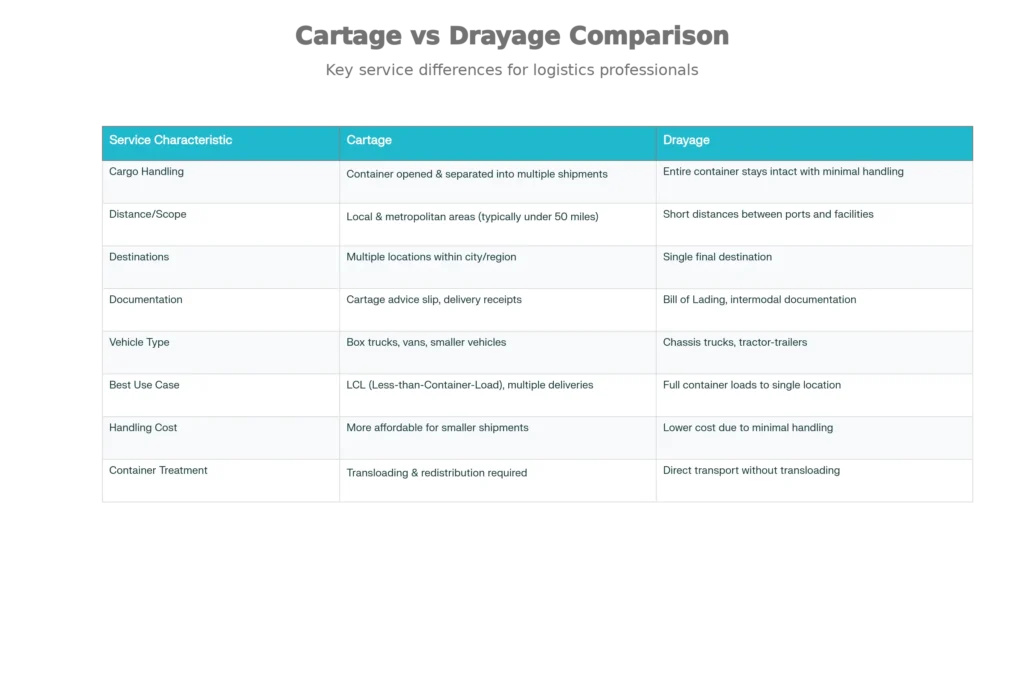
While cartage and drayage both facilitate short-distance freight movement, they serve distinctly different operational purposes within supply chains. The differences are material for logistics professionals selecting appropriate services:
Cargo Handling Methodology. In drayage operations, containers remain sealed and intact throughout transport, with cargo handled only at the final destination. Cartage, by contrast, involves opening containers and redistributing contents into smaller loads for multiple delivery locations. This transloading requirement distinguishes cartage as a consolidation and distribution service rather than a direct container transport service.
Documentation Requirements. Drayage shipments utilize the Bill of Lading as primary documentation, reflecting international standards and intermodal transport protocols. Cartage operations employ cartage advice slips and simpler delivery receipts, reflecting the local, less formalized nature of regional distribution.
Vehicle and Infrastructure Requirements. Drayage utilizes chassis trucks and tractor-trailers designed for container transport from ports to distribution facilities. Cartage employs box trucks and vans, offering flexibility for navigating congested urban streets and accessing facilities lacking heavy-lift equipment.
Cost Structure and Efficiency. Drayage’s minimal handling reduces operational complexity and costs for full-container shipments to single destinations. Cartage’s multiple delivery points increase handling frequency but enable cost efficiency for less-than-container-load shipments distributed across numerous locations.
Operational Challenges and Solutions
Cartage operations encounter specific environmental and logistical challenges that impact service reliability and cost efficiency:
Urban Traffic Congestion. Metropolitan areas present persistent congestion challenges, particularly during peak hours. Melbourne experiences truck queues exceeding two hours during peak periods, directly impacting delivery schedules and increasing operational costs. Route optimization software utilizing real-time traffic data helps mitigate these delays.
Time Constraint Management. Strict delivery windows and just-in-time supply chain requirements demand precise scheduling and operational flexibility. Unforeseen delays—from vehicle breakdowns to customs holds—require contingency planning and proactive communication with stakeholders.
Capacity Constraints. Cartage vehicles’ limited load capacity restricts applicability for heavy or bulky shipments, necessitating alternative transportation methods for certain cargo categories. Businesses with substantial freight volumes may require hybrid transportation strategies combining cartage with drayage or full-truckload services.
Coordination Complexity. Integrating cartage services into larger, multimodal logistics networks requires seamless coordination among freight forwarders, carriers, customs brokers, and warehouse operators. Communication failures at integration points create bottlenecks and service delays.
Technological Integration and Modernization
Contemporary cartage operations increasingly leverage advanced technologies to enhance visibility, optimize routes, and reduce costs:
Real-Time Tracking Systems. GPS-enabled tracking platforms provide customers with shipment visibility throughout the transportation cycle. Real-time location data enables proactive management of delays and supports arrival notifications for receiving facilities.
Route Optimization Software. AI-powered algorithms analyze traffic patterns, road conditions, vehicle capacity, and delivery windows to generate optimal routing. These systems minimize fuel consumption, reduce driver hours, and improve on-time delivery performance.
Digital Communication Platforms. Cloud-based logistics platforms facilitate real-time communication among cartage providers, clients, and other supply chain partners. Digital documentation reduces paper processing, accelerates customs clearance, and creates transparent audit trails.
Reefer Monitoring and IoT Integration. For temperature-sensitive goods, IoT sensors continuously monitor cargo conditions, alerting stakeholders to temperature deviations and enabling proactive intervention before cargo damage occurs.
Fleet Performance Analytics. Telematics systems track driver behavior, fuel efficiency, vehicle maintenance requirements, and service performance metrics. Data-driven insights enable continuous improvement and support vendor management decisions.
Role in Modern Supply Chains
Cartage has become increasingly critical within contemporary supply chains, driven by three major structural shifts:
E-Commerce Proliferation. Explosive growth in direct-to-consumer commerce has elevated last-mile delivery to a competitive differentiator. Cartage services enable same-day and next-day delivery promises that define modern e-commerce competitive advantage.
Just-in-Time Inventory Models. Manufacturing and retail operations increasingly adopt just-in-time supply chain practices, requiring frequent, predictable cartage movements to maintain optimal inventory levels and minimize carrying costs.
Port Automation and Container Consolidation. As ports implement automated container handling systems, cartage providers facilitate faster container retrieval and distribution, converting port automation benefits into operational value for consignees.
Conclusion
Cartage represents a specialized, essential logistics service engineered for short-distance, local freight movement within metropolitan and regional areas. Its operational distinction from long-haul freight and container drayage reflects fundamentally different requirements: cartage prioritizes flexibility, rapid turnaround, and multi-point distribution, while accepting capacity and distance limitations inherent to urban operations.
For supply chain professionals, cartage service selection requires careful evaluation of shipment characteristics, destination requirements, timing constraints, and cost parameters. The distinction between cartage and drayage—while both short-distance services—carries material implications for operations, documentation, and cost management. Integration of modern tracking, routing optimization, and digital communication technologies has enhanced cartage service reliability and visibility, solidifying its role as the critical final link connecting global supply chains to local customers and facilities.