

Third-party, fourth-party, and fifth-party logistics (3PL, 4PL, and 5PL) represent successive layers of supply chain outsourcing, each offering distinct operational models, cost structures, and strategic capabilities. The progression reflects a fundamental shift from task-based outsourcing (3PL) through integrated network management (4PL) to technology-driven supply chain orchestration (5PL). Selecting the appropriate model hinges on four critical variables: business complexity, annual logistics spending, internal expertise, and growth trajectory. Small-to-mid-sized businesses typically optimize around 3PL, enterprises with complex multi-node networks benefit from 4PL, while organizations managing global supply chains increasingly adopt 5PL for competitive advantage.
Core Structural Differences
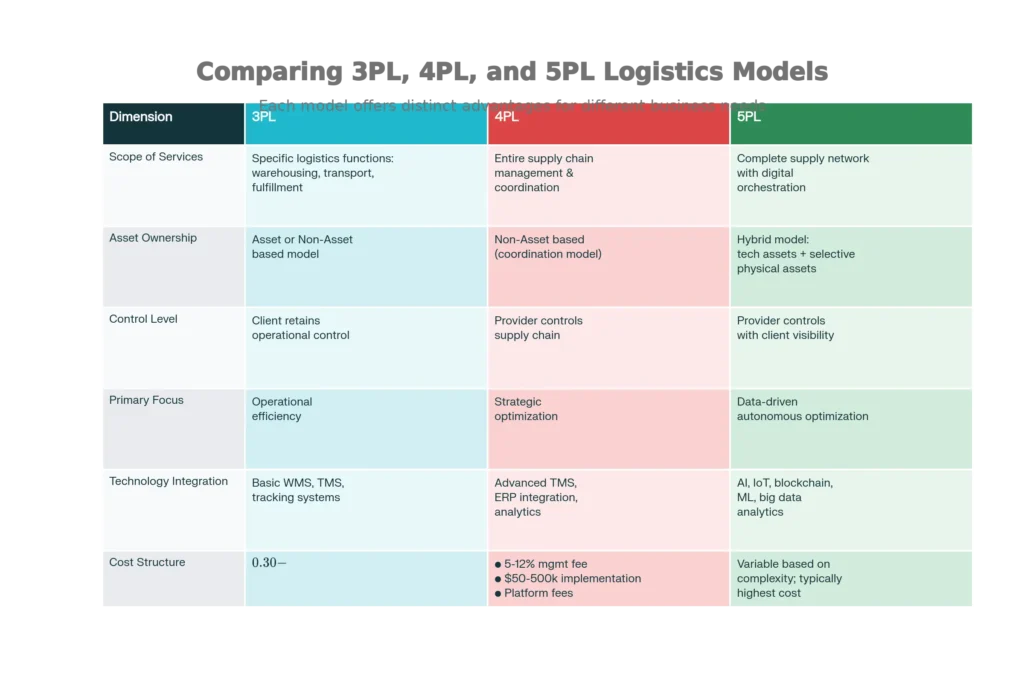
3PL (Third-Party Logistics) functions as a specialized operator managing discrete logistics functions on behalf of the client. These discrete functions include warehousing, inventory management, order fulfillment, and transportation. The fundamental characteristic is that the client business retains strategic control of the overall supply chain and coordinates with the 3PL provider to execute specific operational tasks. 3PLs can be asset-based (owning warehouses, trucks, and equipment) or non-asset-based (brokering services through external networks). The relationship is transactional and task-focused, typically involving activity-based pricing structures.
4PL (Fourth-Party Logistics) represents a structural advancement where a single external provider assumes responsibility for managing the entire supply chain, functioning as an integrated coordinator across multiple 3PLs and carriers. Unlike 3PLs, 4PL providers are typically non-asset-based, meaning they do not own the physical infrastructure but instead orchestrate and optimize a network of logistics partners on the client’s behalf. This model positions the 4PL as the single point of contact between the client and all logistics service providers, fundamentally shifting accountability from task execution to strategic supply chain performance. The relationship is strategic and partnership-oriented.
5PL (Fifth-Party Logistics) extends beyond supply chain management to supply network optimization using advanced digital technologies. A 5PL operates as both a supply chain integrator and technology enabler, managing multiple 3PL and 4PL relationships simultaneously while employing artificial intelligence, Internet of Things (IoT), blockchain, and machine learning to create autonomous, self-optimizing logistics systems. Unlike its predecessors, 5PL simultaneously manages multiple clients’ supply chains while integrating with broader supply networks rather than focusing on individual supply chains in isolation.
Control, Visibility, and Accountability
The degree of control exercised by the client business inversely correlates with the sophistication level. With 3PL, the client maintains operational oversight and can adjust services through direct communication with the provider. However, this direct control introduces complexity when managing multiple 3PLs across different regions or functions, as the client must coordinate independently.
4PL providers assume strategic responsibility for supply chain performance through centralized control and coordination. This transfer of control alleviates the client’s burden of managing multiple logistics relationships, providing enhanced visibility through unified platforms and consolidated reporting. However, it requires accepting reduced direct control over daily operations and placing significant trust in the 4PL’s strategic decisions.
5PL models further abstract control by embedding it within technology platforms. Real-time dashboards and predictive analytics replace manual intervention, providing visibility without the need for operational control. The client benefits from data-driven decision-making capability while the 5PL provider maintains autonomous optimization authority.
Asset Ownership and Operational Models
Asset ownership distinguishes these models fundamentally. Asset-based 3PLs own and operate warehouses, transportation fleets, and material handling equipment, providing dedicated capacity and consistent service levels but limited flexibility. Non-asset-based 3PLs act as brokers, leveraging external carrier and warehouse networks to provide flexibility and scalability but with less direct control over quality and variable pricing.
4PL providers, by definition, function as non-asset-based orchestrators. This non-asset orientation allows them to remain neutral arbiters when selecting among multiple service providers, avoiding the conflicts of interest that arise when a provider prioritizes utilization of its own assets. Some 4PLs employ hybrid models, maintaining strategic assets while operating brokerage arms for peak capacity or specialized needs.
5PL providers operate through technology infrastructure (software, data platforms, AI systems) rather than physical logistics assets. However, some 5PLs maintain selective physical assets when operationally advantageous, particularly for high-volume networks where owned infrastructure improves cost efficiency.
Technology Integration and Capabilities
Technology sophistication escalates markedly across the three models. 3PLs typically employ Warehouse Management Systems (WMS) for inventory control and basic Transportation Management Systems (TMS) for route planning, with tracking dashboards for visibility into shipment status. Technology serves an enabling role for operational execution rather than strategic optimization.
4PLs leverage advanced technology stacks integrating Enterprise Resource Planning (ERP) systems, sophisticated TMS platforms, and business intelligence tools that analyze data across multiple providers to identify optimization opportunities. 4PLs use technology to create unified interfaces across disparate systems, reducing information silos and enabling coordinated decision-making across the supply network.
5PL providers deploy cutting-edge technologies transforming logistics from reactive to proactive systems. Artificial intelligence powers demand forecasting and inventory optimization, IoT sensors provide real-time asset tracking and condition monitoring, blockchain ensures transparent and tamper-proof transaction records, and machine learning algorithms continuously refine route optimization and predictive models. These technologies create feedback loops where system performance improves autonomously over time.
Cost Structures and Financial Models
Pricing mechanisms reflect the operational complexity and value delivered at each level. 3PLs employ activity-based pricing, charging per discrete transaction: receiving fees ($0.30–$0.60 per unit), monthly storage ($5–$20 per pallet), pick-and-pack fees ($2–$5 per order), and shipping costs based on carrier rates. A business shipping 10,000 orders monthly typically incurs $240,000–$300,000 annually. This transparent, proportional pricing aligns costs directly with utilization, making 3PL economical for businesses with predictable, modest volumes.
4PL providers charge management fees representing 5–12% of total logistics spend, plus implementation fees ranging from $50,000 to $500,000 and annual platform fees of $10,000–$50,000. Many 4PLs employ gain-share models that reward cost reductions, creating alignment between the provider’s profit and the client’s savings. Despite higher upfront costs, 4PL clients typically achieve 10–25% reductions in total supply chain costs, generating return on investment within 18–24 months. For enterprises spending $2–3 million or more annually on logistics, these savings exceed the management fees.
5PL pricing remains less standardized given the model’s relative immaturity, but generally involves significant initial investment in platform setup and integration, with variable ongoing fees based on complexity and volume. ROI typically materializes within 12–24 months for qualifying enterprises, primarily through demand forecasting improvements, inventory optimization, and automated route selection.
Scope of Services and Business Fit
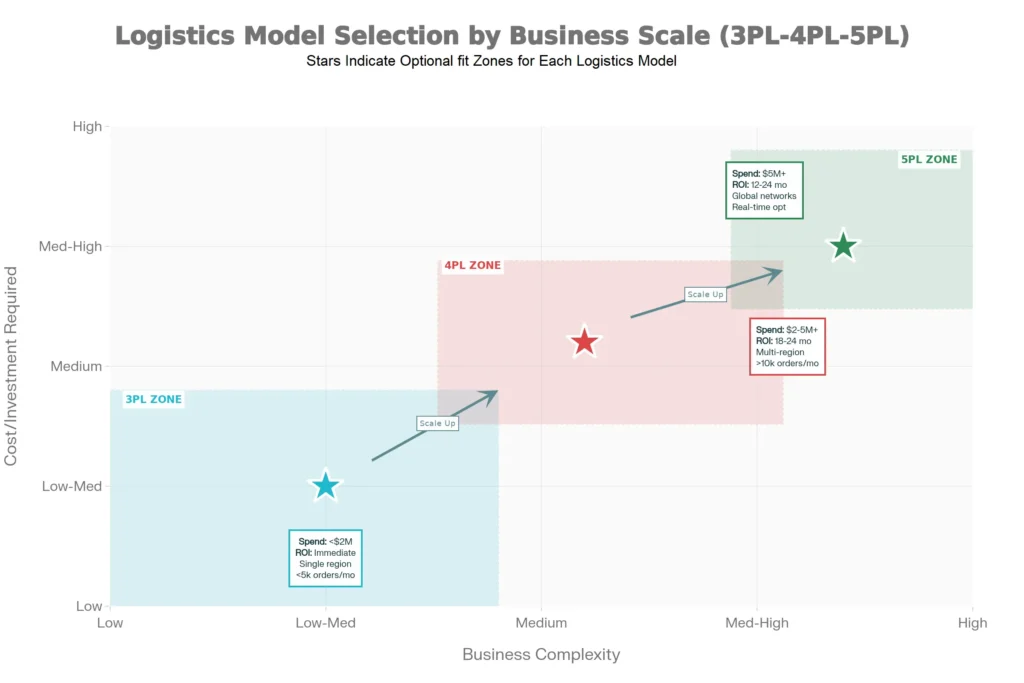
3PL deployment suits small-to-medium-sized businesses with simpler logistics requirements. Organizations shipping fewer than 5,000 orders monthly benefit from straightforward transactional pricing and the ability to maintain direct control over packaging, branding, and customer experience. Retail businesses, small e-commerce brands, and regional distributors typically find 3PL optimal. The model accommodates growth through capacity expansion but does not fundamentally optimize network architecture.
4PL is optimized for medium-to-large enterprises operating across multiple regions or with complex supplier-to-customer networks. Organizations shipping more than 10,000 orders monthly and facing challenges with inventory visibility across warehouses, supplier coordination, or multi-channel distribution typically transition to 4PL. The model excels for companies experiencing rapid growth seeking to scale logistics without building internal infrastructure. Enterprises in pharmaceuticals, medical devices, automotive components, and global e-commerce commonly employ 4PLs.
5PL targets the largest, most complex global organizations managing multiple supply chains simultaneously, requiring real-time visibility across borders, and competing in time-sensitive markets where forecast accuracy directly impacts competitive position. E-commerce companies operating across continents, manufacturing conglomerates with intricate supplier networks, and organizations pursuing sustainability goals through optimized routing benefit from 5PL’s capabilities.
Industry-Specific Applications
Healthcare and pharmaceutical supply chains exemplify where model selection directly impacts patient outcomes. 3PLs excel at specialized warehousing and compliance management; organizations like Pfizer utilize 3PLs operating validated cold-chain facilities for vaccine distribution, leveraging provider expertise in temperature control and regulatory compliance. As supply chains become more patient-centric, some healthcare organizations transition to 4PL models integrating manufacturing, distribution, and hospital inventory systems for visibility from production to point-of-care.
E-commerce retailers encounter distinct challenges across business maturity stages. Early-stage direct-to-consumer brands leverage 3PLs for cost-effective order fulfillment across single warehouses. As these companies scale across regions and channels, managing inventory levels, optimizing fulfillment from multiple nodes, and coordinating returns become complex; transitions to 4PL typically occur at this inflection point. Mature platforms like major online retailers increasingly employ 5PL for multi-channel orchestration, same-day delivery capability, and predictive inventory positioning across networks.
Manufacturing supply chains with just-in-time (JIT) components rely on 3PLs for specialized handling but increasingly require 4PLs for supplier coordination and demand planning visibility. Organizations producing spare parts face particular complexity due to SKU proliferation and supplier fragmentation, making 4PL strategic oversight valuable.
Critical Advantages and Trade-Offs
3PL Advantages: Immediate cost reduction through carrier negotiation and asset utilization, high flexibility in service configuration, minimal upfront investment, rapid implementation, and preservation of direct control over logistics operations. 3PLs excel when business processes are stable and volume is predictable.
3PL Disadvantages: Limited network optimization across multiple regions, communication delays when coordinating between multiple providers, reduced supply chain visibility relative to higher-tier models, and inability to identify systemic inefficiencies spanning multiple logistics segments. Organizations lose economies of scale through independent provider negotiations.
4PL Advantages: Unified coordination reducing complexity from the client’s perspective, access to diverse provider networks enabling flexible capacity management, potential 10–25% cost savings through systematic optimization, improved visibility into full supply chain performance, and strategic partnership supporting long-term growth initiatives. 4PLs can architect network design (warehouse locations, carrier assignments, inventory positioning) to match business strategy.
4PL Disadvantages: Higher costs through management fees, extended implementation timelines, reduced flexibility in crisis situations (a single provider failure affects the entire network), over-dependence on provider performance creating vendor risk, and organizational loss of internal logistics expertise. Companies must cede significant control to an external partner, requiring high trust and alignment.
5PL Advantages: Autonomous optimization reducing manual decision-making, real-time supply chain visibility enabling rapid responses to disruptions, data-driven insights revealing competitive advantages, ability to simultaneously manage multiple supply networks, and access to predictive capabilities impossible for traditional models. Organizations can focus on product and customer strategy while logistics operates autonomously.
5PL Disadvantages: Higher operational costs relative to 3PL and 4PL, significant organizational dependency on a single technology platform, immature provider market with limited options, extended implementation requiring substantial data sharing and integration, and complexity that may exceed organizational needs for simpler supply chains. The model remains evolving with limited long-term performance benchmarks.
Strategic Decision Framework
Selection between 3PL, 4PL, and 5PL should flow from systematic assessment of four dimensions:
Supply Chain Complexity: Simple, single-region logistics favor 3PL; multi-location networks with cross-regional optimization needs indicate 4PL; global supply networks requiring autonomous orchestration suggest 5PL.
Annual Logistics Spending: Organizations spending less than $2 million annually typically realize insufficient savings from 4PL management fees to justify the transition; spending between $2–5 million represents the inflection point where 4PL ROI becomes favorable; spending above $5 million increasingly justifies 5PL investment.
Internal Expertise: Businesses maintaining robust logistics teams may prefer 3PL to preserve control; organizations lacking logistics expertise should escalate to 4PL for strategic guidance; companies pursuing digital transformation benefit from 5PL’s technology integration regardless of expertise level.
Growth Trajectory: Early-stage companies requiring flexibility and capital preservation should begin with 3PL; scaling companies expanding regions or channels should plan transitions to 4PL; mature organizations pursuing competitive differentiation through supply chain excellence should evaluate 5PL.
Implementation and Transition Pathways
The natural evolution follows a progression. Organizations typically begin with 3PL during formation, graduate to 4PL when operational complexity overwhelms internal management capacity, and adopt 5PL when digital capabilities become competitive necessity. Transitions require careful change management; the shift from 3PL to 4PL involves relinquishing operational control in exchange for strategic partnership, a psychological and organizational adjustment. 4PL to 5PL transitions require organizations to embrace data sharing, accept algorithmic decision-making, and trust autonomous systems—cultural shifts with training implications.
Successful transitions occur incrementally. Many organizations employ parallel models during transition, maintaining portions of existing relationships while scaling new partnerships. This approach mitigates disruption risk while validating new models before full commitment.
Emerging Considerations and Industry Evolution
The logistics industry rapidly absorbs emerging technologies influencing model evolution. Blockchain application in 5PL environments enables transparent multi-party transactions without intermediaries, potentially reducing reliance on single-provider orchestration. Autonomous vehicles and drones reshape last-mile delivery economics, making 5PL’s optimization algorithms essential for route selection in dynamic transportation environments. Sustainability imperatives drive supply chain redesign where 5PLs leverage AI to minimize transportation distances and consolidate shipments, reducing carbon footprints.
The boundary between 4PL and 5PL continues blurring as 4PL providers incorporate AI and advanced analytics into their platforms. Industry terminology lags actual capability distribution; some providers market themselves as 4PL while delivering 5PL capabilities, and conversely, some 5PL platforms operate with 4PL-level technology. Organizations should evaluate providers on actual capability rather than nominal classification.
Conclusion
The 3PL-4PL-5PL progression reflects escalating sophistication in supply chain outsourcing, each model optimizing for distinct business scales and complexity profiles. 3PL serves as the foundational model for businesses requiring specialized logistics functions without comprehensive supply chain restructuring. 4PL advances to integrated network management, critical for enterprises scaling across regions where unified coordination drives substantial cost and service improvements. 5PL represents the technology-enabled frontier, delivering autonomous optimization for global organizations where supply chain performance directly influences competitive positioning.
No single model represents universal superiority; selection should reflect honest assessment of business complexity, financial capacity for management fees, internal expertise levels, and strategic priorities. Many large organizations maintain hybrid approaches, employing 3PLs for routine regional operations, 4PL for complex cross-regional coordination, and 5PL pilots for emerging markets or high-complexity initiatives. As supply chains increasingly determine customer experience and organizational resilience, the logistics partnership model selected becomes a strategic business decision equivalent in importance to make-versus-buy decisions for core products and services.